

GLP-1 Prescription Medications: Uses and Safety
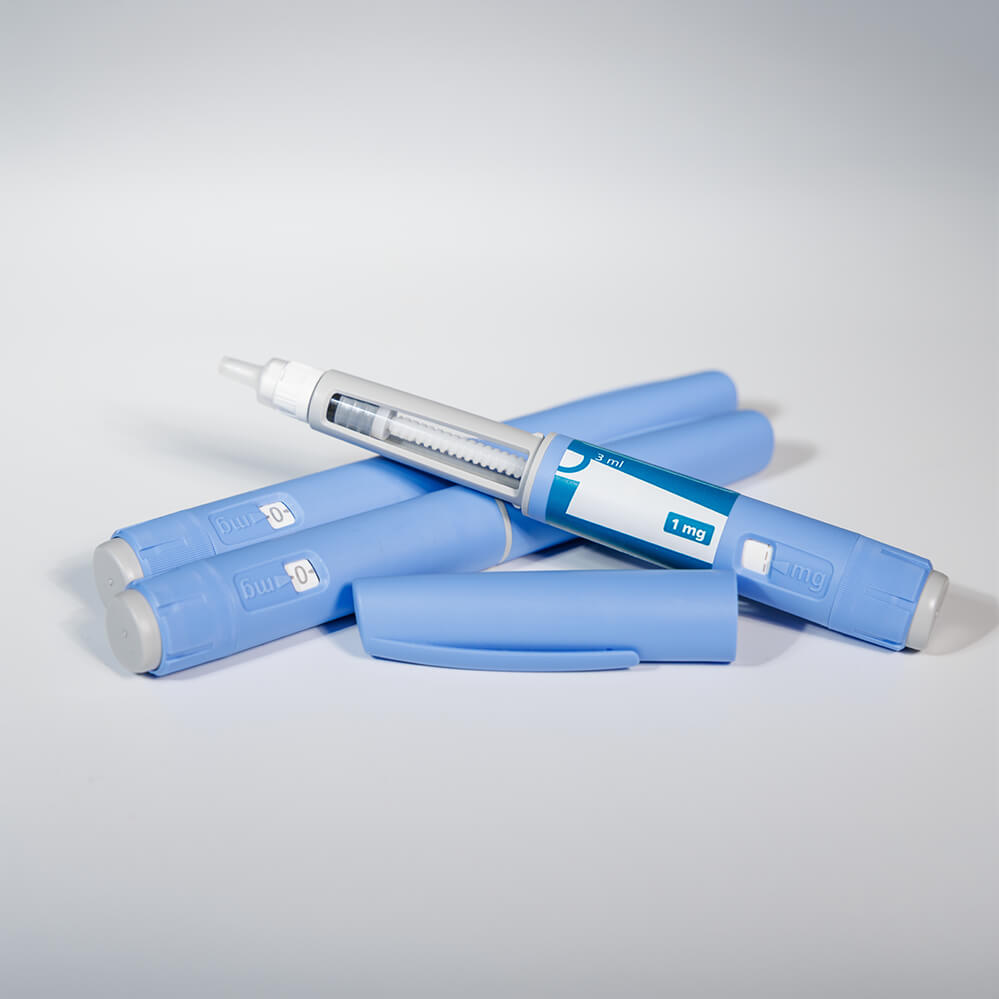
What are glucagon-like peptide-1 (GLP-1) receptor agonists?
Glucagon-like peptide-1 receptor agonists, commonly known as GLP-1 drugs, are a class of peptide medications (not dietary supplements) primarily used to treat type 2 diabetes (T2D) and obesity. These drugs work by increasing insulin levels in the body, which decreases blood glucose (sugar). They also target areas of the brain that regulate appetite and signal you to feel full, which suppresses appetite and can result in weight loss.
Currently, the Food and Drug Administration (FDA) has approved seven GLP-1 prescription medications:
| GENERIC NAME | BRAND NAME | FORMS |
|---|---|---|
| Semaglutide | Ozempic® Rybelsus® Wegovy® | Injection Oral Pill |
| Tirzepatide | Mounjaro® Zepbound® | Injection |
| Liraglutide | Victoza® Saxenda® | Injection |
| Dulaglutide | Trulicity® | Injection |
| Exenatide | Byetta® | Injection |
| Lixisenatide | Adlyxin® | Injection |
| Orforglipron* | Foundayo®* | Oral Pill |
When used in addition to a reduced calorie diet and increased physical activity, these medications are FDA approved for one or more of the following:
- Improving blood sugar levels in adults with T2D.
- Reducing excess body weight and keep it off long term in:
- Adults and children aged 12 years and older with obesity.
- Adults who are overweight who also have at least one weight-related medical problem (such as high blood pressure, diabetes, or high cholesterol)
- Reducing the risk of major adverse cardiovascular events in adults with T2D who have heart disease or are at high risk for these events.
Can Service Members use GLP-1 prescription medications?
GLP-1 medications are only available with a prescription from a qualified healthcare provider. Eligibility for a GLP-1 medication depends on a Service Member’s diagnosis, prior authorization, and/or medical necessity.
- Service Members who are overweight with other risk factors or obese should work with their Department of War (DoW) medical officer or Primary Care Manager/Provider to determine if a GLP-1 medication is appropriate before starting these medications.
- The use of GLP-1 medications during training, deployments, or operational platforms might not be authorized. However, they might be allowed on a case-by-case basis, depending on service-specific policies and provider recommendations.
- For full manual prior authorization or medical necessity criteria for GLP-1 medications, please use the TRICARE Formulary Search Tool.
Note that Service-specific and duty-specific policies regarding the use of GLP-1 medications remain under review and are subject to change.
Can providers external to a Military Treatment Facility (MTF) prescribe GLP-1 medications to Service Members?
- Service Members should use providers at their installation’s MTF whenever possible. These providers will be more knowledgeable about service-specific policies regarding GLP-1 medications than providers outside the MTF.
- Civilian doctors who evaluate and treat Service Members for obesity may prescribe anti-obesity medications (such as semaglutide and tirzepatide) but should be familiar with the TRICARE coverage algorithm.
- Service Members should also ensure all their medications are recorded in their electronic military health record and work with their military Primary Care Manager/Provider to ensure their record is updated to reflect any missing prescription medications.
Can Service Members use investigational GLP-1 drugs?
- Short answer: Service Members should avoid using compounded and investigational GLP-1 drugs as they pose severe risks to military health and readiness. Unlike FDA-approved medications (e.g., Wegovy, Ozempic, Zepbound), compounded alternatives lack agency review for safety, quality, and efficacy. FDA actively restricts the distribution of compounded GLP-1 drugs and explicitly advises against their use.
- Retatrutide and cagrilintide
- Are synthetic peptides and investigational new drugs in multiple clinical research trials for the treatment and management of obesity and T2D.
- Even though these substances may be marketed for weight management, they have not been approved by FDA for any use. Per FDA “Retatrutide and cagrilintide cannot be used in compounding under federal law. Additionally, these are not components of FDA-approved drugs and have not been found safe and effective for any condition.”
- At this time, these drugs are only legally accessible to clinical trial patients.
Safety and considerations
- GLP-1 medications are associated with potentially serious side effects, which is why they should not be used unless prescribed and supervised by a military healthcare provider who is familiar with a Service Member’s medical condition and history, as well as other medications and dietary supplements they might be taking.
- FDA has documented over 1000 adverse event reports linked to compounded versions of semaglutide and tirzepatide. However, because “federal law does not require state-licensed pharmacies that are not outsourcing facilities to submit adverse events to FDA,” many cases are likely going undocumented.
- FDA has also “warned companies that have illegally sold unapproved drugs containing semaglutide, tirzepatide or retatrutide that are falsely labeled “for research purposes” or “not for human consumption.” These products have been sold directly to consumers for human use with dosing instructions. The agency urges consumers not to purchase these products which are of unknown quality and may be harmful to their health.”
- GLP-1 prescription drugs should not be confused with “GLP-1 dietary supplements.” These products marketed to “boost GLP-1 naturally,” “promote weight loss,” or “provide nutritional support for those taking GLP-1 medications” contain a variety of dietary supplement ingredients, not actual GLP-1 drugs.
Bottom Line
- GLP-1 drugs are prescription medications, not dietary supplements. They should only be used under the supervision of a qualified healthcare provider.
- “GLP-1 dietary supplements” are not actual GLP-1 prescription drugs.
- Before starting any GLP-1 medication, Service Members should work with their DoW medical officer or Primary Care Manager/Provider to ensure it is medically appropriate and to review how it might affect deployments, training, and overall readiness.
Additional Resources
- Phentermine: A prescription drug for weight-loss – OPSS
- Berberine: The hype for “Nature’s Ozempic” – OPSS
- Weight-loss dietary supplements: What you should know – OPSS
Posted 3 June 2026

